
PROCEDURAL STEPS ON ASSESSMENT AND VERIFICATION IN FILING COURT PROCESSES IN THE FCT
HIGH COURT OF THE FEDERAL CAPITAL TERRITORY, ABUJA. PROCEDURAL STEPS
BY SAM ELEANYA
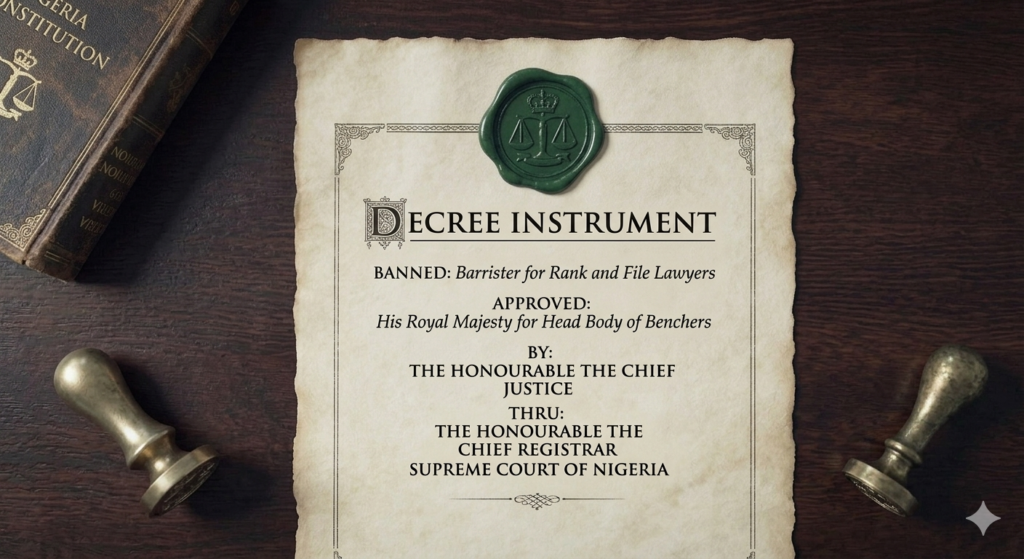
On July 13, 2026, the Supreme Court of Nigeria issued an official memorandum aimed at sanitizing the linguistic landscape of the legal profession. Signed by the Chief Registrar, Kabir E. Akanbi, Esq., the circular explicitly barred litigation staff, legal practitioners, and court registrars from using the prefix “Barrister” before their names, pronouncing it “inappropriate and inconsistent with the standards of professionalism expected within the Supreme Court of Nigeria.”
On its face, the directive seems a welcome intervention. The habit of converting a professional description into an informal honorific prefix has long been an unnecessary, otiose vanity unique to the Nigerian space. Yet, the deep irony of the memorandum lies not in what it bans, but in the language it uses to issue the ban. The directive is explicitly framed as coming from “the Honourable the Chief Justice of Nigeria” and is issued through the grandiosely styled office of “The Chief Registrar.” The order, to be enforced, would require the institutional support of the Office of the Attorney-General—headed by a “Prince”—as well as the Body of Benchers—headed by a “His Royal Majesty” (HRM).
This creates a stark institutional paradox. The highest echelon of the legal machinery demands aesthetic minimalism and functional humility from the rank-and-file, while jealously guarding its own aristocratic lexicon. It aggressively attacks the speck in the average lawyer’s eye while remaining blind to the rotten, neo-monarchical beam holding up its own house.
The Transatlantic Contrast: Functional vs. Feudal Administration
To appreciate the sheer absurdity of Nigeria’s judicial and justice administration aristocracy, one must look at the foreign jurisdictions whose administrative models Nigeria purports to mirror, if not ape.
In the United States—the republic after which Nigeria’s constitutional and presidential system is patterned—the administrative officer running the highest court in the land is known simply as The Clerk of the Supreme Court. The American system would never tolerate a non-ceremonial public communication from its highest court using the dramatic phrasing of a colorful village politician. Notices go forth plainly on behalf of “The Chief Justice.” There are no monarchical flourishes, no feudal baggage, and no artificial titles designed to elevate the public servant above the Republic. The intent is to ensure that the duty to be judicial and judicious—is not just tokenistic but that it permeates and serenades, substantively, over every aspect of the Court, in line with the reformed values of the Puritans and Pilgrims whose existential need for a true Republic led to the founding of the US—away from the monarchical underbellies of paganism, Catholicism, Anglicanism and islamism which, to varying degrees, dominated the Europe they had fled to look for their own proverbial “City on the Hill”.
Even the United Kingdom, the global bastion of royal sovereignty and the source of Nigeria’s common law heritage, taking a cue from the same USA which under that serious republican rail-guards had overtaken the UK in global stature, has steadily marched away from its historically archaic ceremonialism. Over the years, the UK Supreme Court has progressively dismantled its surfeit of dramatic titles, choosing instead to identify the head of its registry simply as The Registrar.
Nigeria, conversely, has birthed a toxic mutation. It has grafted the pompous, archaic remnants of British colonial administration onto the competitive vanity of indigenous tribal royalty. The result is a constitutional republic operating its apex court registry like a medieval fiefdom complete with elites and brokers beholden to dinosaur relics and investitures.
The Ground-Level Cesspool: The Case of Mararaba Division of a State High Court
The obsession with inflating titles at the peak of the pyramid creates a direct, permissive cover for systemic and functional rot across the entire administrative value chain. The true weight of this judicial decay is exposed right under the nose of the Chief Justice and the apex court, on the doorstep of the nation’s Federal Capital Territory, with the Mararaba Division of the Nasarawa State High Court—a satellite town of Abuja—serving as Ground Zero.
In this jurisdiction, titles and offices are extra-legally fluid. A single court clerk can officially act as a member of the Registry receiving processes into the court, act as a bailiff serving processes out of the court, and serve as a “Commissioner for Oaths” endorsing the sworn depositions of litigants. Similarly, a single court bailiff in Mararaba functions—with the full knowledge and affirmation of the presiding High Court Judge—concurrently as a one-stop clearinghouse, operating as the Commissioner for Oaths, the Registrar, and the Bailiff. This ensures that a lawsuit—including sensitive matrimonial matters adjudicated under the Matrimonial Causes Act on behalf of the same Supreme Court framework—can be disposed of in a matter of weeks with cartel efficiency.
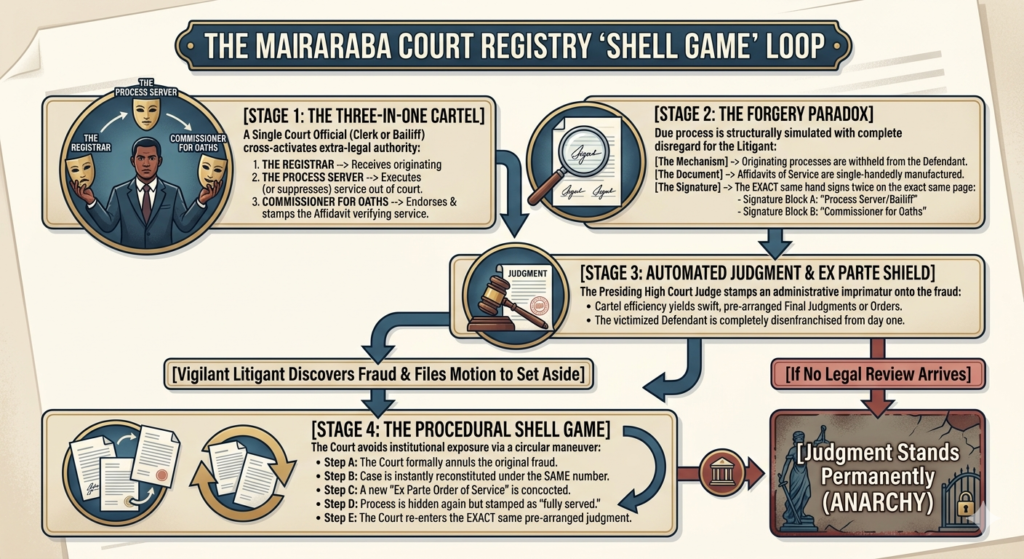
This structural collapse yields inevitable, fraudulent results. Defendants and respondents are routinely denied service of originating processes. Instead, affidavits of service are single-handedly manufactured, forged, and stamped by the exact same officer—be it a clerk or a bailiff—who purports to execute them. Indeed, it is routine for filed affidavits of service to feature the identical signature of a clerk or bailiff signing in both the space reserved for the process server and the space reserved for the Commissioner for Oaths.
When a vigilant litigant uncovers this fraud—often after judgment has already been entered—and applies for the proceedings to be set aside, the institutional response is telling. No censure is meted out to the lawyers maintaining this corruption, nor to the illegal operators of the registry system. Instead, the court engages in a classic shell game: it simply annuls the fraudulent proceedings, only to turn around a few days later, reconstitute the exact same case under the exact same case number using a similarly concocted ex parte order of service—which is then deliberately withheld from the defendant but still affirmed as served—and re-enter the exact same pre-arranged judgment.
If this brazen, multi-layered mockery of due process occurs in Mararaba, right beside the federal center of power—with most of its cases flowing from the Federal Capital Territory, brought by lawyers who forum-shop precisely for these corrupt dynamics—one can only shudder to imagine the lawless environment within the judiciary in more remote, unmonitored provincial and rural enclaves farther removed from the proverbial nose of the Supreme Court.
The SAN Caste System: The Corruption of Youth and Apprenticeship
This obsession with grandeur does not stop at the registry doors; it flows downward, transforming the Senior Advocate of Nigeria (SAN) designation into an exclusionary caste system. Rather than acting as a peer-reviewed badge of genuine professional excellence, the rank has mutated into a mercantilist cartel that is warping the soul of the legal order and destroying its foundational apprenticeship system.
To cross the threshold into the inner bar, a lawyer must fulfill a checklist of material vanity:
Younger lawyers watching this circus learn a corrosive lesson early in their careers. They see that rigorous legal scholarship, ethical devotion, and genuine client care yield little institutional reward. They are trained instead to chase flash over substance, pursuing political connections, monetization, and outsized material stature.
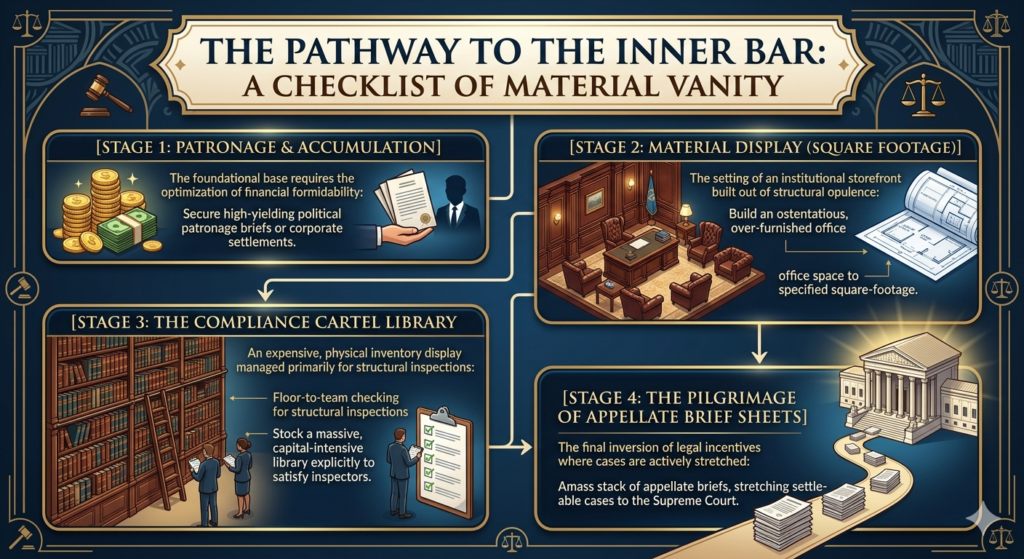
Historically, the legal profession thrived on a sacred apprenticeship model. Young lawyers put in years of grueling, substantive grunt work beside seasoned seniors, learning the delicate art of client counseling, ethical practice, and holistic dispute resolution. Under the current SAN matrix, these puritanical practitioners are routinely bypassed.
Instead, the system over the past few decades has rewarded legal honchos ready to rumble in the litigious wrestlemania of political patronage or bitter corporate cases. Exactly because those arenas demand the legal asphyxiation of the opposing side—much like a poisonous scorpion stalking and disabling its prey—the criteria for the inner bar and the conferment of the SAN title have become heavily weighted toward appellate-level briefs, thereby completely inverting the incentive structure of Nigerian lawyering.
Once, as remains the case in functioning climes, great lawyering was synonymous with the wisdom and craft required to dissolve disputes at the pre-litigious stage, or at the very least, the dexterity to win a case cleanly at the court of first instance. This preserved commercial relationships, protected human dignity, and ensured business functionalism.
In Nigeria, that functionalism is now little more than an eschatological utopia to be preached at the annual Bar Conferences and forgotten after a few rounds of drinks at the grand finale party, which is usually funded by largesse donated by those who do not practice their craft with an eschatological frame of mind. Thus, today’s ambitious Nigerian lawyers are actively incentivized to stretch straightforward, settle-able cases—both criminal and civil—all the way to the Supreme Court. Scores of cases struck out on grounds of jurisdiction linked to procedural defects—which could and should be immediately re-commenced for the benefit of the clients—suffer through decades of an appellate-level pilgrimage, only to be struck out on the same grounds with little, if any, consequence for the lawyers, who then cite those very cases for their own professional advancement. Consequently, hapless litigants are dragged through decades of hung reliefs, bankrupt businesses, and fractured relationships, treated as mere fuel to power a lawyer’s appellate statistics sheet
.
The Garden and Fruits of Titular Vanity
The legal elite’s behavioral patterns are institutional, systemic, and endemic. For in the same week the Supreme Court issued its titular purge of the “Barrister,” the Head of the Body of Benchers—the very body responsible for the Call to Bar of those same lawyers as Barristers and Solicitors of the Supreme Court—His Royal Majesty Albert Akpomudje, SAN, FCIArb, the Eyavwien-Alaka I, the Ohworode of the Ancient Olomu Kingdom, stepped into a jarring constitutional contradiction. HRM Akpomudje, SAN, FCIArb, now ensconced on a monarchical throne for life, “decreed” an extra-constitutional plan to place an artificial quota on the number of law school graduates in the country. This life-altering Decree against the right to dignity of Nigerians aspiring to become lawyers completely ignores the fact that in a constitutional republic, treating professional education as a royal fiefdom which restricts social mobility and gives the legal profession the appearance of a tightly controlled legal cartel is wholly unsupportable within Nigeria’s Republican Constitutional framework.
This obsession with grandeur, dynastic coupling, and “royalty” breeds an environment of unparalleled professional lawlessness, as evidenced by recent enforcement against the highest tiers of the inner bar. On July 15, 2026, a massive blow was dealt to elite impunity when the Federal High Court ordered the final forfeiture of ₦213 billion in assets linked to the former Attorney-General of the Federation, Abubakar Malami, SAN.
Malami’s tenure perfectly defined the “royalty complex”—treating public office as a vehicle to construct an empire of 57 properties while cloaking himself in grandiose traditional honorifics as the Alkalin-Alkalan Gwandu—a title translating directly to the monarchical “Chief Judge or Judge of Judges of Gwandu.” To bolster his outsized political and presidential formidability, Malami actively sought to graft his title directly into the ultimate seat of power. Despite already maintaining an established marriage, he made history as the first sitting Attorney-General of the Federation to marry the daughter of a sitting President, taking Nana-Hadiza Buhari as his third wife in an exclusive, closed-door villa ceremony. This was not a partnership born of legal merit; it was an aggressive, dynastic calculation designed to convert state authority into absolute royal entitlement. This calculus was also intended to further his then-immediate plan to become the Governor of Kebbi State, thereby attaching constitutional immunity from prosecution for his extensive grafts—a venture that, fortunately for the Republic, did not materialize.
This institutional decay extends directly to current state actors and past historical precursors. The current Attorney-General of the Federation and Minister of Justice, Prince Lateef Fagbemi, SAN—who aggressively projects his traditional title of Prince alongside his inner bar rank—was recently rebuked and fiercely resisted by the Nigerian Bar Association (NBA) for issuing directives affecting the conduct of the 2026 NBA elections. His intervention was widely perceived as a calculated attempt to favor a specific candidate for the office of the NBA Presidency who had been endorsed by the regional socio-cultural legal group, the Egbe Amofin O’odua. Instead of ensuring institutional impartiality and protecting democratic access for all candidates through the proper operationalization of universal suffrage for all legal practitioners, his interference threw the process into disarray. This maneuvering ultimately led to a shambolic election wherein another candidate—actively favored by the sitting NBA President—emerged, even though an inordinately large number of Barristers (sorry, lawyers) were completely disenfranchised.
Instructively, Prince Fagbemi seems to have bet his institutional “legacy” on another extra-constitutional alteration of the Laws of the Federation of Nigeria (LFN). He has done this through the ongoing work of the Law Review Committee he unilaterally appointed to “update” the LFN 2004, despite having zero constitutional remit to hijack the legislative powers of the National Assembly through the backdoor. It cannot but be so that the Nation’s top prosecutor and Chief Law Officer has absolutely no business trying to become a primary lawmaker by sneaking substantive alterations into the entire legal code of the nation under the guise of a scrivener executing mere “law reviews.”
Similarly, on July 29, 2026, the Legal Practitioners Disciplinary Committee (LPDC) delivered a sweeping judgment that shook the inner bar’s elite, slapping Chief Joe-Kyari Gadzama, SAN—a titan holding the traditional title of Chief—with a severe three-year suspension from legal practice for taking over another lawyer’s brief and wrongfully appropriating professional fees tied to the Zaki Biam massacre case [2026/LPDC/SUSP/07].
But perhaps the ultimate baseline for this systemic hubris was established by the landmark Supreme Court affirmation against Chief Michael Kaase Aondoakaa, SAN. Aondoakaa, heavily laden with localized chieftaincy honorifics including The Ivaaniyange of the Tiv Nation (the “man who fights for his people”) and The Tsar-U-Tiv mba Sha Nasarawa, was formally damned by the apex court.
The Supreme Court upheld a historic verdict ruling that Aondoakaa was “not a competent, fit, and proper person to hold any public office in Nigeria” after he crudely deployed his powers as the sitting Attorney-General to undermine the administration of justice and block a validly elected candidate from taking a legislative seat. The apex court’s pronouncements captured the sordid low of his tenure, proving that the accumulation of traditional stools and legal preferments serves only to cover up severe institutional subversion.
These cases offer a grim foretaste of what happens when the judiciary of a constitutionally republican nation turns itself into a new royalty. The SAN caste system structurally privileges the cases of the hyper-wealthy who can afford elite retainers, allowing their matters to jump the queue while the regular citizen waits years for a hearing.
Jurisdictional Evolution: The Complete Abandonment of Fiduciary and Constitutional Duties
The legal wasteland and procedural purgatory into which the recent case of Chief Joe-Kyari Gadzama, SAN has been consigned demonstrates that the structural complications of this title-servicing culture have real, devastating consequences. These systemic failures do not merely affect the millions of ordinary people who approach the judiciary for relief; in their full bloom, they come back to consume the very elite who benefit from and maintain the perfidy. Every sustainable legal order relies on an interconnected web of professional responsibilities. The Bar owes a strict duty of diligence, candour, and exhaustive research to the Bench. Concurrently, lawyers owe a duty of absolute care and protection to their clients—including fellow legal practitioners fighting for their livelihoods and professional survival within disciplinary proceedings.
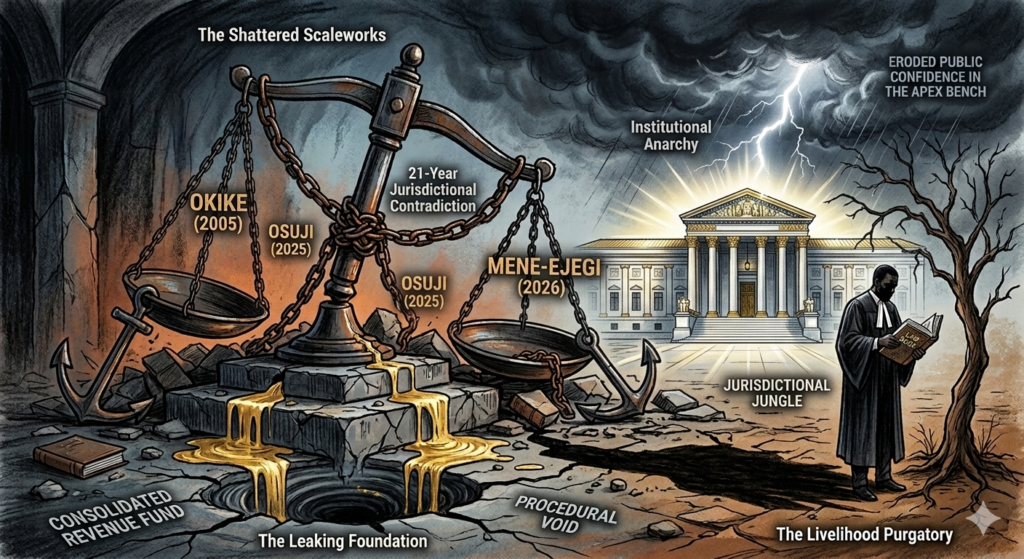
At the apex of this structure sits the Judiciary, which owes an inherent, non-negotiable constitutional duty to the sovereign Republic. Chief among these is the obligation to substantively uphold the foundational presumption of the rule of law: jura novit curia—the absolute principle that the Court knows, understands, and accurately maintains the state of the law. This is not a voluntary public service; it is a solemn constitutional mandate heavily funded as a first-line charge on the Consolidated Revenue Fund of the entire Federation.
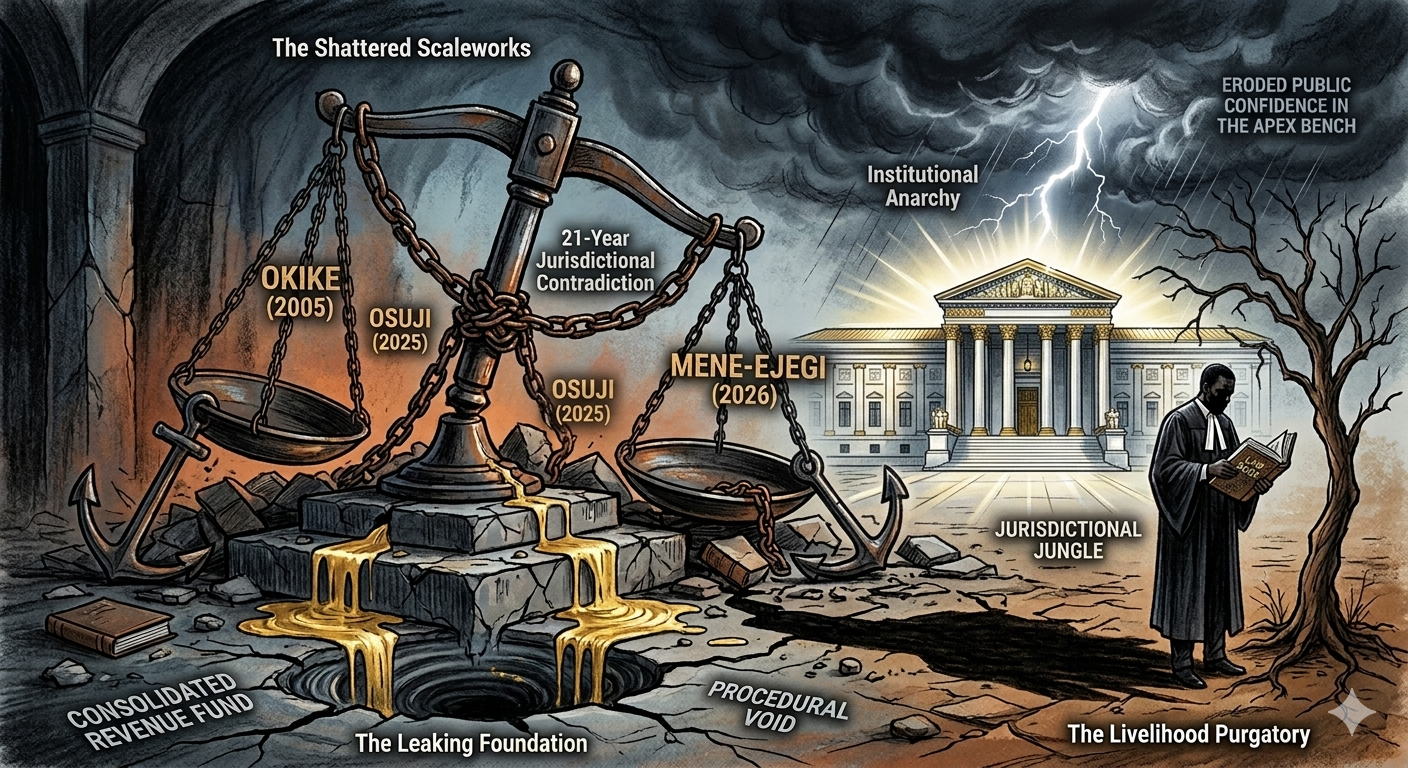
Yet, a critical look at the appellate trajectory of bar discipline reveals that this entire apparatus of duty has been completely abandoned by all major stakeholders. This breakdown is starkly illustrated by the recent judgment delivered on June 26, 2026, by a seven-Justice panel of the Supreme Court in Ben Mene-Ejegi v. Nigerian Bar Association & Legal Practitioners Disciplinary Committee (SC/481/2018, per Mohammed Baba Idris, JSC).
For over twenty-one years, the legal profession and the apex court operated under the deeply flawed assumption that the Supreme Court possessed the statutory authority to hear direct appeals from the Legal Practitioners Disciplinary Committee (LPDC). This direct pipeline was treated as settled law by successive generations of Senior Advocates, prosecutors, and defense counsel, heavily relying on the apex court’s own decision in Charles Okike v. LPDC (2005) 7 SC (Pt. III) 75.
The fact that it took more than two decades for the Supreme Court to finally raise this jurisdictional question suo motu in Mene-Ejegi (2026)—only to discover that Section 233(1) of the 1999 Constitution (as amended) had plainly confined its appellate jurisdiction to the Court of Appeal all along—indicts the entire system. It exposes a profound failure of candour and diligence by the elite members of the Bar, who repeatedly failed to look at the foundational text of the Constitution while arguing cases before the inner bar.
For more than twenty years, scores of ambitious legal practitioners built their very applications for the coveted rank of Senior Advocate of Nigeria upon the foundation of their participation as “learned counsel” in Okike and the extensive line of unconstitutional appellate cases that followed it. Entire professional profiles, lucrative retainers, and elite reputations were manufactured out of these invalid direct appeals. It was a macabre, multi-decade theater of the absurd—a gilded legal elite meticulously building “something” on absolute “nothing.” Under the watchful, approving gaze of the apex bench, a tower of professional status and outsized financial rewards was constructed upon a jurisdictional void, proving that the currency of the inner bar has long been prestige and political patronage rather than rigorous constitutional fidelity.
More damningly, it shatters the presumption that the Court knows the state of the law. For twenty-one years, the apex bench blissfully exercised an unconstitutional jurisdiction, applying the flawed reasoning of Okike without ever independently verifying its own constitutional boundaries alongside Section 240.
By finally applying the canon expressio unius est exclusio alterius in Mene-Ejegi, the Court correctly struck down Section 12(7) of the Legal Practitioners Act and overruled Okike. However, because the intermediate Appeal Committee architecture of the Body of Benchers had already been structurally dismantled under Osuji v. L.P.D.C. (2025) 17 NWLR (Pt. 2014) 317, this sudden judicial awakening has inadvertently plunged the entire profession into a chaotic, unlegislated vacuum. No valid statutory conduit currently exists to route LPDC matters to the Court of Appeal.
In this sprawling jurisprudential wreckage, Chief Joe-Kyari Gadzama, SAN emerges not as the primary victim, but merely as an incidental sacrificial goat. When the LPDC announced his sweeping three-year suspension on July 29, 2026—just a month after Mene-Ejegi—the learned silk’s strategy to appeal directly to the Supreme Court to trigger an automatic stay of execution under Section 11(8)(a) of the LPA was instantly neutralized.
There is an ironic, almost tragic symmetry at play: Gadzama, a towering pillar of this very inner bar cartel, has for decades fed fat on the bitter-leaf tree of this titles-and-patronage ecosystem. Now, the leaves of that very tree are being harvested to sauce the boiling pot in which his own professional flesh is being cooked. Because the Bar and the Bench preferred the intoxicating aroma of elite status to the rigorous discipline of constitutional alignment, the legal machinery has simply devoured one of its own makers. Gadzama finds himself trapped in a lawless void of his own caste’s making—stripped of a competent appellate forum because his peers chose to polish their handles while the engine of the law fell apart.
But let there be no mistake: Gadzama’s stranded livelihood is a sideshow. The real, immediate, and live casualty of this collective abandonment of duty is the public’s right to have confidence that Nigeria’s justice administration complex possesses any shred of seriousness, gravity, functionality, and wisdom.
We live in a deeply troubled epoch. Nigeria is besieged by systemic insecurity, fracturing tribal allegiances, economic precarity, and a terrifying descent toward lawless self-help. In such a volatile climate, the judiciary is supposed to be the anchor of civil society—the final, sober bastion where intellect and absolute predictability defeat chaos.
Instead, the public is forced to watch an apex court, heavily funded by the Consolidated Revenue Fund, flounder through three messy, uncoordinated bites at the cherry over three separate decades just to comprehend its own basic disciplinary jurisdiction.
This shatters the core social contract of justice. If the physician cannot heal itself—if cases concerning the wellbeing, reputation, and livelihood of lawyers themselves, prosecuted by lawyers, defended by elite SANs, and adjudicated by Supreme Court Justices, can be completely broken by decades of systemic negligence—then what kind of dark, unmonitored skullduggery is happening to the cases of unlearned, everyday citizens?
If the high priests of the law cannot accurately locate the doorway to their own disciplinary temple, the ordinary, impoverished litigant stands absolutely no chance. This complete evacuation of institutional intellect does not just leave disciplined lawyers in limbo; it sends a chilling signal to a panicked nation that there is no one at the wheel of the law, driving a weary public away from institutional faith and directly into the waiting arms of anarchy.
The Supreme Court and the high echelon of Nigeria’s legal system must look into the mirror. They must reform their own archaic language, their monarchical practices, their ostentatious garbs, and their exclusionary docket systems. Until the inner bar addresses the aristocratic beam blinding its own eyes, its decrees against the petty vanities of younger lawyers will remain nothing more than the duplicitous expressions of an empty Republic.
HIGH COURT OF THE FEDERAL CAPITAL TERRITORY, ABUJA. PROCEDURAL STEPS
CENTER FOR LAWS OF NIGERIA: FEDERAL LAWS Constitution Federal Laws
POLICY AND PRACTICE LAW REPORTS, 2PLR: LAGOS STATE GOVERNMENT GAZETTE/NOTICES